Laparoscopic Intra-abdominal Solid Organ Surgeries in Jaipur (Liver, Spleen, Pancreas, Kidney, Adrenal)
Laparoscopic pancreas surgery:
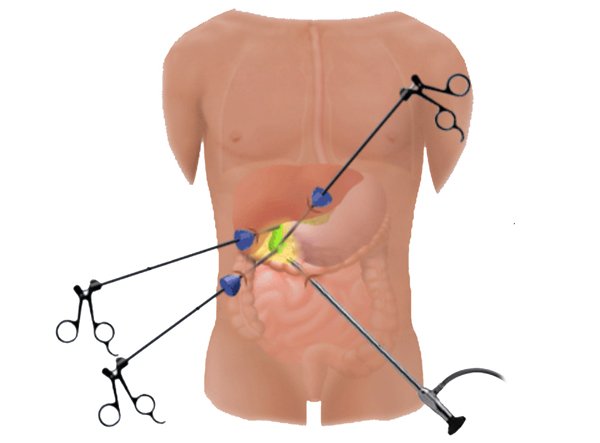
Laparoscopic pancreas surgery allows candidate patients to minimize some of the standard risks and discomfort associated with a standard open operation. Laparoscopic surgery is typically performed using 3 or 4 half-inch or one-inch incisions, sparing patients a large incision. Fine surgical instruments are used to carve out a tumor or remove an entire section of the gland, after the nearby blood vessels are controlled.
The deep and central location of the pancreas in the abdomen, coupled with its "wet sponge" texture, make it a unique organ for surgeons to conquer. Adding to the complexity of pancreas surgery, the pancreas lacks a capsule, or covering, and is thus prone to bleed or leak juices with even a small degree of rough handling. For these reasons, we recommend that pancreas surgery be performed by a specialist who is familiar with standard tissue handling techniques for the pancreas.
Our specialists work collaboratively with a multidisciplinary team of physicians at Massachusetts General Hospital to determine the treatment plan that is best for each patient.
Laparoscopic pancreas surgery:
Laparoscopic pancreas surgery allows candidate patients to minimize some of the standard risks and discomfort associated with a standard open operation. Laparoscopic surgery is typically performed using 3 or 4 half-inch or one-inch incisions, sparing patients a large incision. Fine surgical instruments are used to carve out a tumor or remove an entire section of the gland, after the nearby blood vessels are controlled.
The deep and central location of the pancreas in the abdomen, coupled with its "wet sponge" texture, make it a unique organ for surgeons to conquer. Adding to the complexity of pancreas surgery, the pancreas lacks a capsule, or covering, and is thus prone to bleed or leak juices with even a small degree of rough handling. For these reasons, we recommend that pancreas surgery be performed by a specialist who is familiar with standard tissue handling techniques for the pancreas.
Laparoscopic Kidney Surgery:
Traditionally, kidney surgery required large incisions with lengthy hospitalization and recovery. Minimally invasive surgery, also often known as laparoscopic or keyhole surgery, has recently been developed in the field of urologic surgery with the advancement of engineering and computer technologies.
How laparoscopic kidney surgery works
During laparoscopic surgery your physician makes a series of small incisions in your lower abdomen and inserts a tiny tube with a light and a camera (i.e., a laparoscope) to access the kidney.
The surgeon navigates and inspects the region on a TV-like monitor that receives images from the camera. Once in place, your doctor can visualize tissue, biopsy suspicious regions, remove tumors, or even remove the kidney with a cutting instrument and tissue retrieval apparatus that is also part of the laparoscope.
Laparoscopic adrenal surgery
In the past, making a large 6 to 12 inch incision in the abdomen, flank, or back was necessary for removal of an adrenal gland tumor. Today, with the technique known as minimally invasive surgery, removal of the adrenal gland (also known as “laparoscopic adrenalectomy”) can be performed through three or four 1/4-1/2 inch incisions. Patients may leave the hospital in one or two days and return to work more quickly than patients recovering from open surgery. Results of surgery may vary depending on the type of procedure and the patients overall condition.